Helping students learn about potential careers
Pam Krill recently took position as Community Workforce coordinator

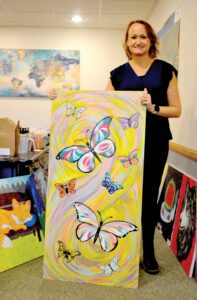
Pam Krill, above, was recently hired by Community and Economic Development Associates (CEDA) to be the new area Community Workforce coordinator.
Pam Krill says she feels as though she might have found the perfect job for her to do.
Krill has become the new Community Workforce coordinator for the Blue Earth Area, United South Central, and now also the New Richland-Hartland-Ellendale-Geneva school districts.
The schools actually contract with Community and Economic Development Associates (CEDA), which is the entity that hired Krill as the coordinator.
She replaces the former Community Workforce coordinator, Emily Davis.
“I started this job 30 days ago, and I love it,” Krill says. “I work with teachers and with students in the three schools, and I love going to work each day.”
Krill says she collaborates with teachers about programs they can do to have students explore possible future careers.
She has already had three field trips with students to go and explore careers they might be interested in.
One trip was to the city of Faribault for a job fair where students could learn about careers in law enforcement and other fields. There was a Construct Tomorrow expo in Mankato where students could learn about welding, running an excavator, plumbing and construction, among other trades.
“I have taken 55 USC students and 25 NRHEG students on field trips already,” Krill says. “We are planning more things to do, such as visiting the county offices, doing mock interviews at the schools and many other things.”
There is also going to be a mobile medical unit at USC soon, which Krill says should be fun and interesting.
Her goal is to open up opportunities for the students, to learn what is possible.
“They don’t all need a four-year college degree for many careers,” Krill explains. “There are many paths they can take, so many things they can do.”
Krill took some interesting paths of her own, in her lifetime.
She was born and raised in the small town of Kingston, Minnesota, population 161, and located north of Dassel and south of St. Cloud.
Right out of high school she joined the military and spent just over 21 years in the Air Force. She retired nine years ago, after doing stints in Iraq in 2008 and two stints in Afghanistan from 2011-2012 and again in 2013-2014.
She was a logistics specialist with a rank of a master sergeant E-7. Eventually she decided it was time to retire.
“We were living in Colorado Springs where I was stationed and working as a recruiter,” Krill says. “My son said he was ready for me to retire, so I did.”
She and her son, Donovan, now 21, moved to an acreage in the country south of Guckeen in 2015. She says she bought a house that once had been a horse barn, and she loves it.
“I first worked for Mayo for four and a half years in Fairmont and then the Social Security office in Fairmont for one and a half years,” Krill explains. “Then I was the Faribault County Central Services director for just over a year.”
She says she had some personal reasons why she left the county job.
“I really did not know what I was going to do next, or if I would just try to live off my military pension,” she says. “That might have been rough.”
But then she talked to Annie Nichols, of CEDA, and found out about the opening for the Community Workforce coordinator. She applied and was hired.
“I had a lot of learning to do,” Krill says. “Emily (Davis) left a lot of information and she had done a lot of work on creating things for the future of this position.”
On the other hand, Krill has learned that as far as new ideas and things to do, the field is wide open for her.
“My goal is to help students explore all of their options for future career paths,” Krill says. “Whether that includes college or not. But college is not necessarily not an option, either. It will be right for some, not for others.”
She says she wants to open up different opportunities for the students to explore, and she will be working with teachers and administrators about ways they want to try to implement this.
“I want to show the students how important it is to have fun at your job, too, whatever that job is,” Krill explains. “It is true that you need to make money to support yourself, but if you don’t enjoy what you are doing for work, you will not be happy.”
Local News
County passes roadside memorial policy
Veterans Day programs set for Nov. 11