Mammoth bones returned to county
First discovered near Frost in 1921, they were lost for decades
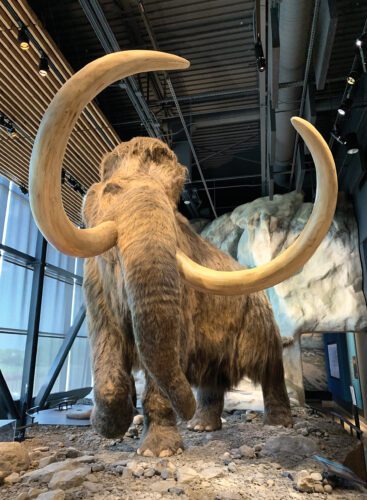
This woolly mammoth greets visitors to the Bell Museum in the Twin Cities. Mammoth bones from Faribault County were found in the basement of that museum.
Some 10,000-year-old (or older) mammoth bones that were dug up in Faribault County more than 100 years ago have finally been returned to the county where they were first discovered, after having gone missing for decades.
They were eventually tracked down by Faribault County Historical Society executive director Randy Anderson. The bones were in the basement of the Bell Museum of the University of Minnesota in St. Paul.
The story of how Anderson found the bones and then retrieved them is pretty involved.
“I had heard the stories about mammoth bones being found in Faribault County, but I really did not know much about it,” Anderson says. “But then I learned more about them purely by accident.”
The historical society had been contacted by someone from Rhode Island asking if Anderson could locate their great-grandmother’s wedding announcement in the 1922 Blue Earth Post newspaper.
“When I opened the 1922 bound volume of newspapers it opened to a front page in October and there was a story about mammoth bones being found in the county,” Anderson says. “It was a reprint of a story that first appeared in the Winnebago newspaper.”
The reason it was in the Winnebago newspaper was because the bones were on display in the window of the Andrews and Hendall’s hardware store in Winnebago, before they were taken to the Twin Cities by a geology professor from the University of Minnesota named George Thiel.
But that reprinted 1922 article did not say exactly where the bones of the giant-sized, elephant-like mammoth were discovered in the county, only mentioning Brush Creek Township.
“I had given some thought to possible locations in Brush Creek that could have yielded the bones, but I had no good leads,” Anderson says. “But it turns out the newspaper article was incorrect, it was not in Brush Creek, but instead it was right on the line between Elmore and Blue Earth townships.”
How Anderson found that out is another lucky accident.
“Al Roesler contacted me and told me about his daughter, Hannah Voermans, finding something interesting,” Anderson says. “And it was about the mammoth bones.”
Voermans, who lives in Brooklyn Center, home schools her daughter. She was looking up interesting facts about dinosaurs and mammoths to use in a lesson and found an article from a 1924 scientific publication that told all about the discovery of mammoth bones in Faribault County, including detailed descriptions of the bones – and the exact location where they were found.
She recognized the location as being the farm where her parents live in Faribault County.
That location is on County Road 4, about four miles west of the town of Frost, or eight miles southeast of Blue Earth.
Al and Susan Roesler live on one side of the road and Tim and Barb Steier are on the other side of the road.
“A bridge was being constructed in 1921 during the extension of County Ditch No. 8,” Anderson says. “I learned from some folks at the Winnebago Area Museum that a contractor from Winnebago, Babcock and Babcock, was doing most of the road construction work in the county 100 years ago, and one of the employees, Clyde Otterson had some connection with the owners of the hardware store. So that is probably how the bones got put on display at the Winnebago hardware store.”
That 1924 article, plus another one by the same paleontologist in 1945, gave Anderson a lot more information about the Faribault County mammoth bones and he says it refocused his interest in tracking down the location of these bones.
Anderson began a search for the mammoth bones and sent out many emails and made many phone calls.
Eventually a 2024 search of the Bell Museum basement turned up two sets of unmarked mammoth bones and after some research, the Zoological Collections Manager at the Bell Museum, Angela Hornsby, agreed the bones were no doubt the ones from Faribault County, and on April 14 of this year, she agreed they could be returned to Faribault County.
Anderson notes that a list of bones that were found include two giant tusks, but those somehow were pilfered before the arrival of the U of M geology professor and have never been found.
Some of the bones listed in old documents are also not among those that were recently returned. In all, the bones include pieces of vertebrae, ribs, a radius, head of a humerus and a femur, three tarsal bones and various other fragments.
Anderson says it is not unlikely that other large bones such as the skull, shoulder blades and pelvis remain in the ground at the original site.
“There is strong interest among several local folks to return to the site where the bones were discovered,” Anderson says. “And to probe the area a bit in the hopes of finding other remains.”
He points to valuable clues in the 1924 article about the area being a former glacial lake and that movement of the bones away from the site would be very limited.
The original bones were found seven to 10 feet deep below the surface in layers of clay and sand. That, too is promising.
For now, the bones that were found 100 years ago will soon be on display at both the Etta C. Ross Museum and at the Southern Minnesota Museum of Natural History, both in Blue Earth.
“We plan to have a lot of them on display at the museum at the fairgrounds during the Faribault County Fair,” Anderson says. “I think there will be a lot of interest from people wanting to see them.”
Local News
County passes roadside memorial policy
Veterans Day programs set for Nov. 11