Wells City Council discusses Strategic Plan for city
Future of City Hall, renovation of downtown buildings are hot topics
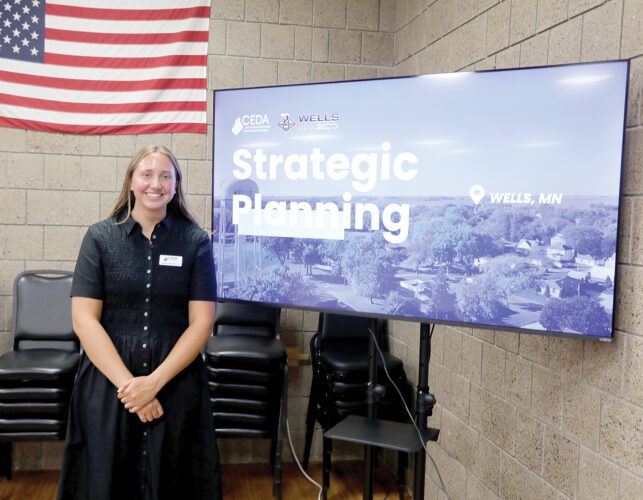
CEDA community and business development specialist Sarah Schrauth, pictured above, presented the Wells City Council with an overview of the Strategic Plan at their meeting on Monday, July 27.
The Wells City Council met on Monday, July 27, to listen to an overview of the Strategic Plan developed by CEDA (Community and Economic Development Associates) for the city of Wells.
Sarah Schrauth, a community and business development specialist with CEDA, presented the plan to the council and the 15 or so members of the public who attended the meeting.
“Many cities do not have a strategic plan,” Schrauth said. “This is a short-term plan that looks three to five years into the future.”
Schrauth explained that the Strategic Plan offers a clear framework for Wells to move forward by helping the city set priorities, guide resources allocation and strengthen the collaboration between local government and the community.
“This plan is designed to turn discussion into action,” Schrauth commented. “It outlines strategies to support new housing, strengthen the tax base and expand development using existing resources.”
She proceeded to talk about a SWOT (strength, weaknesses, opportunities and threats) analysis, one of the first things which was done at the beginning of the process.
“Strengths which were identified include the strong community assets, including a wide variety of local businesses, abundant recreational amenities, strong emergency and medical services and a school district that is growing,” Schrauth said. “At the same time, residents and leaders identified challenges such as vacant buildings and overall appearance along Broadway, limited retail and lodging options, accessibility concerns, aging streets and the need for more diverse employment opportunities and long-term capital planning.”
Opportunities included available land, open storefronts, strong volunteer involvement, active HRA and EDA programs and access to a wide range of state, federal and nonprofit grants.
“The threats which were identified were that progress may be affected by limited local funding, uncertainty around outside grant programs and shifts in the agricultural economy,” Schrauth remarked. “It was also noted there is increasing competition from larger regional centers and on-line services.”
Schrauth also shared a community profile summary of what Wells looks like today.
“The total population is 2,409 and the median age is 46.3,” Schrauth stated. “There are 871 jobs in Wells, the median household income is $58,663 compared to $64,391 for Faribault County and 72.5 percent of the homes were built before 1970.”
Through a community survey it was learned that residents desired more restaurants, an auto parts store, an eye/vision clinic and to enhance downtown by having more businesses.
Eventually the presentation moved to the topic that seemed to be on the minds of most of people in attendance – what to do about City Hall?
The purpose of this meeting was not to discuss actual financial numbers but to outline the process the council will be going through as things move forward.
“They will be assessing and analyzing the cost to benefit ratio of fixing and improving the current City Hall building versus possibly moving the location,” Schrauth commented.
One person asked if there would be enough room for the Police Department if City Hall were to relocate to the former Mayo Clinic building. The answer was yes.
“Why would we drop money into relocating instead of putting the money into fixing up the current building?” asked another person.
Another attendee expressed their thoughts, “Moving City Hall or demolishing it defeats the purpose of making downtown beautiful. But you expect business owners to keep their buildings beautiful.”
Wells EDA specialist Hallie Raimann offered her thoughts by framing the problem in a different way.
“The question becomes, is it worth the taxpayers’ dollars to fix it or to move City Hall and demolish the old building,” Raimann offered. “It has to be determined what makes sense.”
Mayor David Braun pointed out that one of the problems is that it is a government-owned building.
“If the City Hall building was privately owned it would be cheaper to fix,” Braun said. “Since it is government owned there is more red tape to deal with.”
Raimann then raised another question.
“How many dollars does the public want to spend to maintain the theater,” she asked.
It was pointed out that many downtown buildings face similar problems of moisture and sewer issues.
“It’s not anybody’s fault,” one person pointed out. “Codes were different when the buildings were built.”
It was pointed out that there are still many things to be determined such as could City Hall be demolished and leave the theater standing and what are the cost estimates for all of the different options?
As for the timeline for any action, council member Crystal Dulas shared the council’s thoughts.
“Nothing will be done until after the Highway 109/22 Project going through town is done,” Dulas commented. “That needs to be finished first.”
Local News
Preliminary levy hike in BE at 24.2%
The Blue Earth City Council passed Resolution 26-43 setting the 2027 preliminary tax levy at a total of $3,251,000 ...
Wells preliminary levy at 25.1% hike
The Wells City Council meeting on Sept. 28 was rolling right along and after 17 minutes there was only one item ...