Preliminary levy hike in BE at 24.2%
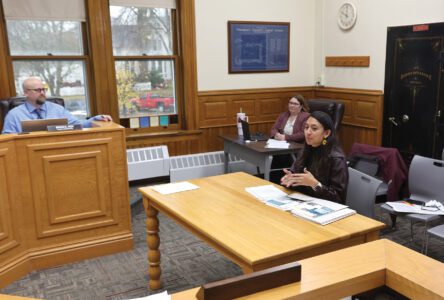
Council holds budget work session, special meeting
The Blue Earth City Council passed Resolution 26-43 setting the 2027 preliminary tax levy at a total of $3,251,000 at a Special City Council meeting held on Monday, Sept. 28.
This is a proposed increase of $633,482 from the 2026 final tax levy of $2,617,518, or a 24.2 percent increase, and includes $200,000 for the General/Operating Levy, and $3,051,000 for the Debt Levy.
Prior to passing Resolution 26-43, the council held a Special Work Session prior to their meeting to go over the 2027 draft budget, and discuss the changes that had been made since their last meeting.
“I was looking at the Travel/Meeting/Membership line under the Mayor and Council section, and I’m wondering why that amount is so high,” council member Ann Hanna remarked. “I thought we decided last year to not budget any money for travel.”
“Most of that amount is actually for our League of Minnesota Cities membership, which came out to around $4,387 plus an additional four percent to account for inflation,” mayor Rick Scholtes clarified. “We decided to round the value up to $5,000 even, so any leftover funds can be used for travel expenses if needed.”
Hanna acknowledged that this was fine for now, but that in the future, she would prefer to see a more detailed breakdown of how those expenses were divvied up, rather than grouping travel and membership fees together in one line item.
Council member Jacque Drew indicated that she would like to see a line item added to the budget spreadsheet specifically to track data center revenues.
“I’m curious to know how much revenue these data centers are contributing,” Drew explained. “With all of the uncertainty surrounding data centers right now, I think it would be worthwhile to investigate that further and see how much of a difference that makes in our budget.”
Collins then went into a detailed breakdown of each of the funds, pointing out where things had been changed and identifying a couple of funds that were not currently self-sustaining.
“One of the funds that we’ll need to keep an eye on going into 2027 is the Housing Fund,” Collins shared. “According to the current numbers, the estimated revenues are not enough to cover the estimated expenses. I will also point out that the Economic Development Fund will also need to be looked at, but this will be a topic of discussion at future EDA meetings.”
Finally, Collins presented the council with a list of requested capital items from various departments. She explained that while certain items on the list were already accounted for in the preliminary budget, all of the items on the list could be removed from or added to the budget at the council’s discretion.
“The items highlighted in green on the list are those which have been requested, but have not been added to the preliminary budget calculations,” Collins explained. “Those in white have already been factored in, but can still be removed if the council would prefer not to pursue them at this time.”
Mayor Scholtes also reminded the council that once the preliminary tax levy was set, they could not go any higher.
“So if we approve the preliminary tax levy as-is, we would need to make cuts to the General Fund in order to include additional projects from the list of proposed capital items,” Drew remarked. “It feels like we can barely afford what we need right now, let alone what we want. How are we ever going to be able to afford any of these projects?”
Council member Mike McNerny brought up that one reason the budget didn’t have a lot of flexibility was that they were waiting on the bond payments from the various street projects to start dropping off. Collins affirmed this, and reminded the council that even though the budget was tight right now, it wouldn’t stay that way forever.
“I don’t think it was a bad idea for us to do the street projects,” Collins offered. “The amount of debt we have taken on due to those projects gives us an advantage on grant applications in the meantime, and the new streets were specifically requested by the community. It’s true that we’re in a tight spot financially right now, but there will be positive revenue to come.”
“I guess I’m just looking for the light at the end of the tunnel,” Drew replied. “It sounds like we have a lot of work to do.”
Hearing no further discussion, a motion was made and seconded to pass Resolution 26-43, setting the 2027 preliminary tax levy at a total of $3,251,000. The motion passed unanimously.
Local News
County passes roadside memorial policy
Veterans Day programs set for Nov. 11